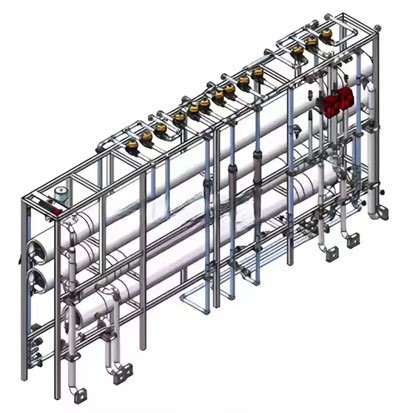


A carbon steel membrane rack is a membrane module bearing device made of Q235 carbon steel as the base material, with the surface treated by epoxy spraying, rubber lining, or anti-corrosion coating. It is mainly used to fix and support membrane elements/modules such as reverse osmosis (RO), ultrafiltration (UF), and microfiltration (MF) membranes. Meanwhile, it integrates pipeline interfaces, sealing structures, and fixing clamps to ensure the stable operation of the membrane separation system throughout the entire process of filtration, backwashing, and chemical cleaning.
Featuring low cost, high mechanical strength, and strong bearing capacity, this equipment is suitable for water treatment scenarios with moderate cleanliness requirements and large treatment scales, such as municipal reclaimed water reuse, industrial wastewater treatment, and large water purification plants, serving as a cost-effective supporting component in membrane separation systems. Its structure can be designed into horizontal, vertical, or skid-mounted types according to membrane module specifications (e.g., 4040, 8040, flat-sheet membranes), directly affecting the operational stability of membrane modules, the convenience of maintenance, and the initial investment cost of the project.
Overview of the Core Principle
The core functions of a carbon steel membrane rack are high-strength bearing, flow channel optimization, and anti-corrosion protection, which are closely coordinated with the sieving/permeation principle of membrane separation. Specifically, they are reflected in three aspects:
High-Strength Bearing and Damage Prevention Principle: The carbon steel base material has excellent tensile and compressive strength. Through welded card slots, end plates, and beam structures, the membrane rack can bear the weight of multiple pressure vessels or membrane modules, offset the axial thrust and radial tension generated by fluid impact during operation, prevent membrane element displacement and membrane rack deformation, and ensure the stable interception efficiency of membrane separation.
Flow Channel Optimization and Energy Reduction Principle: The water distribution plates and main water collection pipes of the membrane rack are accurately connected to the water inlet and outlet ports of the membrane modules, realizing uniform distribution of feed water and independent diversion of concentrated and fresh water. This reduces system frictional resistance, lowers the operating energy consumption of high-pressure pumps/suction pumps, avoids local dead zones, reduces the risk of membrane module fouling, and extends the filtration cycle.
Anti-Corrosion Protection and Adaptation Principle: The anti-corrosion layers (such as epoxy spraying and rubber lining) on the surface of the carbon steel base material can withstand weakly acidic and alkaline working conditions with a pH value of 4-9 and ordinary water treatment environments. They isolate direct contact between water and the carbon steel base material to prevent rust and corrosion of the base material. The smooth surface of the anti-corrosion layer can also reduce impurity adhesion, facilitating daily cleaning and maintenance of the membrane rack.
Product Introduction
Carbon steel membrane racks can be divided into multiple series according to compatible membrane types and structural forms. The core parameters and characteristics are as follows:
1. Classification by Compatible Membrane Type
- Carbon Steel RO Membrane Rack: Compatible with 4040/8040 specification spiral-wound RO membrane elements and pressure vessels, adopting a horizontal pressure-bearing structure with a pressure resistance rating of 1.0-2.5MPa. A single rack can accommodate 1-8 pressure vessels. The end plates are made of thickened carbon steel through welding, with an epoxy spraying thickness of ≥200μm on the surface, which can offset the axial thrust during high-pressure operation. Suitable for working conditions such as municipal reclaimed water reuse and industrial wastewater desalination, its cost is only 50%-60% of that of stainless steel membrane racks of the same specification.
- Carbon Steel UF Membrane Rack: Divided into pressure-type and submerged-type: the pressure-type is compatible with 4040/8040 hollow fiber UF membrane modules, with a pressure resistance of 0.6MPa; the submerged-type is compatible with 10-20㎡ flat-sheet UF membrane modules, integrated with aeration interfaces, and produces water through negative pressure suction. The surface anti-corrosion layer has strong weather resistance, suitable for large-flow working conditions such as quality upgrading and renovation of municipal sewage treatment plants and printing and dyeing wastewater reuse.
- Carbon Steel MF Membrane Rack: Compatible with tubular and hollow fiber MF membrane modules, featuring a simple structure and strong bearing capacity. Suitable for pretreatment of high-turbidity raw water (such as river water and lake water purification), it can effectively intercept suspended solids, algae, and other impurities.
2. Classification by Structural Form
- Horizontal Carbon Steel Membrane Rack: The mainstream industrial structure, with membrane modules installed horizontally, facilitating loading and unloading and stable operation. Compatible with medium and large membrane separation systems (water production ≥100m³/h), it can be designed into single-stage/multi-stage series structures, widely used in municipal, chemical, metallurgical, and other fields.
- Vertical Carbon Steel Membrane Rack: Membrane modules are installed vertically, occupying a small area. Suitable for small membrane systems (water production 30-100m³/h) or scenarios with limited space (such as industrial park wastewater treatment stations). Its disadvantage is that the loading and unloading difficulty of membrane modules is slightly higher than that of horizontal structures.
- Skid-Mounted Carbon Steel Membrane Rack: Integrates membrane rack, pressure vessels, pipelines, valves, and instruments into one unit, prefabricated in the factory. It can operate on-site only by connecting pipelines and power supply, with an installation cycle of ≤5 days. Suitable for large temporary water treatment projects (such as construction site circulating water and mining area wastewater treatment).


Selection Reference Table
|
Model Type |
Compatible Membrane Module Specification |
Anti-Corrosion Process |
Pressure Resistance Rating |
Number of Units per Rack |
Compatible System Scale |
Key Selection Parameters |
Core Adaptable Working Conditions |
|
Horizontal RO-C-8040 |
8040 Spiral-Wound RO Membrane |
Carbon Steel with Epoxy Spraying (≥200μm) |
1.6-2.5MPa |
1-8 Pressure Vessels |
Medium to Large (≥100m³/h) |
Operating pressure, water production, influent pH value |
Municipal reclaimed water reuse, industrial wastewater desalination |
|
Horizontal UF-C-4040 |
4040 Hollow Fiber UF Membrane |
Carbon Steel with Rubber Lining (Butyl Rubber) |
0.6MPa |
1-6 Membrane Modules |
Small to Medium (30-100m³/h) |
Influent turbidity, aeration air volume |
Printing and dyeing wastewater reuse, industrial park water purification |
|
Submerged UF-C-L |
10-20㎡ Flat-Sheet UF Membrane |
Carbon Steel with Anti-Corrosion Coating (Fluorocarbon Paint) |
Atmospheric Pressure |
4-12 Membrane Module Sets |
Large (≥200m³/h) |
Tank size, suction negative pressure |
Municipal sewage quality upgrading, landfill leachate pretreatment |
|
Skid-Mounted C-Q-8040 |
8040 RO/UF Membrane Modules |
Carbon Steel with Epoxy Coal Tar Anti-Corrosion |
1.6MPa |
2-6 Pressure Vessels |
Medium (50-150m³/h) |
Transportation size, hoisting conditions |
Construction site temporary water use, mining area wastewater treatment |
Application Scenarios
With its cost-effectiveness and high bearing capacity, carbon steel membrane racks are widely used in medium and large water treatment projects:
Used for quality upgrading and renovation of municipal sewage treatment plants (Class 1A standard) and reclaimed water reuse systems. Combined with UF membrane modules, it can effectively remove suspended solids and colloids from sewage. The produced water is used for urban green irrigation and road cleaning, reducing the pressure on municipal water supply.
Compatible with advanced treatment of wastewater in printing and dyeing, papermaking, electroplating, and other industries. Combined with RO membrane modules, it realizes wastewater desalination and reuse, reducing the amount of fresh water used by enterprises and lowering sewage discharge costs. In the metallurgical industry, it is used for pretreatment of mineral processing wastewater to intercept slag particles.
As a UF membrane bearing device for surface water purification, the treatment scale can reach thousands of cubic meters per hour, with significant cost advantages. Suitable for rural centralized water supply projects.
Skid-mounted carbon steel membrane racks can be quickly deployed in construction sites, mining areas, oil fields, and other places to treat construction wastewater and oil production wastewater, realizing the recycling of water resources.
Product Features and Achieved Effects
1. Core Product Features
|
Feature |
Specific Description |
|
Low Cost |
Low procurement cost of the base material, the overall price is only 50%-60% of that of 304 stainless steel membrane racks of the same specification, greatly reducing the initial project investment |
|
High Mechanical Strength |
The carbon steel base material has excellent compression and tensile properties, can bear a large number of membrane modules/pressure vessels, suitable for large water treatment systems |
|
Reliable Anti-Corrosion Performance |
Processes such as epoxy spraying and rubber lining can isolate water corrosion, with a service life of 8-10 years under weakly acidic and alkaline working conditions |
|
Modular and Easy to Maintain |
Quick-disconnect clamp design shortens the loading and unloading time of membrane modules by more than 40%, facilitating online cleaning and replacement |
|
High Customization Degree |
The welded structure has strong plasticity, and the size and capacity can be customized according to project requirements, adapting to different site conditions |
2. Practical Application Effects
Ensuring Stable Operation of Membrane Modules
The high-strength bearing structure avoids membrane rack deformation and membrane element displacement, keeping the desalination rate of RO membranes stable above 98% and the produced water turbidity of UF membranes ≤0.1NTU, extending the service life of membrane modules by 1-1.5 years and reducing membrane replacement costs.
Controlling Comprehensive Project Costs
The initial procurement cost is much lower than that of stainless steel membrane racks. In large water treatment projects, it can save 30%-50% of supporting equipment costs; the modular design shortens the on-site installation cycle by 40%, reducing civil engineering and labor costs.
Improving System Operating Efficiency
The optimized flow channel design reduces frictional resistance, lowering the energy consumption of high-pressure pumps by 8%-12%; uniform water distribution reduces local fouling of membrane modules, reducing chemical cleaning frequency by 20% and increasing the continuous operation time of the system.
Adapting to Large-Flow Working Condition Requirements
A single rack can accommodate multiple membrane modules, meeting the flow requirements of large water treatment systems, and helping municipal sewage and industrial wastewater achieve large-scale discharge or reuse up to standard.
Would you like me to help you sort out a carbon steel membrane rack selection comparison table that integrates key parameters and application scenarios for quick reference?
Hot Tags: carbon steel membrane rack, China carbon steel membrane rack manufacturers, suppliers, factory, Ultrafiltration Membrane System, Large Reverse Osmosis System, membrane rack, Stainless Steel Membrane Rack, Carbon Steel Membrane Rack