Artificial Wetland Sewage Treatment Solution
The global market size of artificial wetlands is expected to reach 30.322 billion yuan in 2024, and is projected to grow to 53.269 billion yuan by 2030, with an average annual compound growth rate (CAGR) of 9.85% during the forecast period.
Artificial wetlands are an eco-friendly wastewater treatment technology that purifies water quality through the synergistic action of plants, microorganisms, and substrates. They are widely used in areas such as domestic sewage, industrial wastewater, and rainwater management. In recent years, with stricter environmental policies and the advancement of ecological civilization construction, this industry has entered a period of rapid development.
I. Overview of Artificial Wetland Water Treatment
Jinan Guangbo Environmental Technology Co., Ltd. has been deeply engaged in the field of artificial wetland ecological governance, focusing on improving water quality in river basins, ecological restoration, and the construction of green spaces. The company specializes in providing a full-chain service from scheme design, technological research and development, engineering construction to operation and maintenance for various parks, river basins, and ecological projects.
Relying on years of technical accumulation and project practical experience, the company is skilled at integrating various technical forms such as subsurface flow wetlands, surface flow wetlands, and composite flow wetlands. For different scenarios such as industrial wastewater purification, river basin water environment governance, and ecological corridor construction, it customizes an efficient purification system with "plants - microorganisms - substrates" collaborative action. We adhere to the principle of local adaptation, select aquatic plant varieties with strong pollution tolerance and high ecological adaptability, combine scientific graded fillers and hydraulic design, to ensure stable and long-lasting treatment effects, while also considering ecological diversity and landscape harmony.
Artificial wetland water treatment is a wastewater treatment solution with low investment, low operating costs, ecological friendliness, and landscape benefits. It is particularly suitable for rural areas, small communities, scenic areas, and deep treatment of wastewater from tail water.
With the improvement of environmental protection requirements and the prominent high cost issue of traditional wastewater treatment plants, more and more customers who have demands for economy, ecology, and sustainability are choosing artificial wetland technology. This technology uses the synergy of soil, plants, and microorganisms to purify wastewater, not only meeting discharge standards but also beautifying the environment and creating additional value.


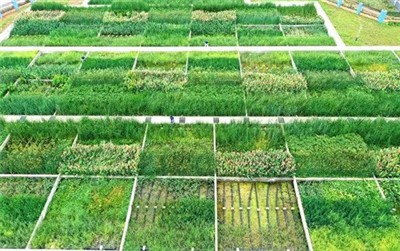
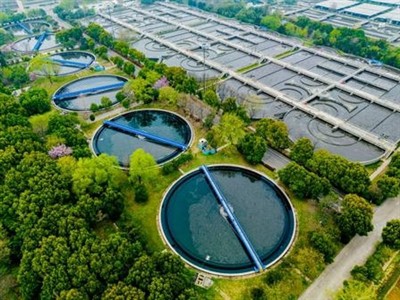
Picture of wastewater treatment by artificial wetland
II. Source of Wastewater for Wetland-Based Sewage Treatment
According to the available data, the common wastewater sources in constructed wetlands mainly include the following categories:
1. Rural domestic sewage: originating from daily discharges such as kitchens, toilets, and washing, characterized by small volume, scattered distribution, and incomplete pipelines, making it highly suitable for on-site treatment using constructed wetlands.
2. Urban residential or community sewage: used as a supplementary or deep treatment unit for centralized sewage treatment plants in small-sized towns or newly built residential areas.
3. Sewage effluent (tail water) from sewage treatment plants: used for further purification of the effluent from secondary treatment, to improve water quality and meet reuse standards or reduce pollution loads to rivers.
4. Pre-treated wastewater from industrial parks: such as from food processing, brewing, and light industry industries after preliminary treatment, which can be treated further using constructed wetlands under the premise of meeting the influent standards.
5. Eutrophic water bodies and lake replenishment: used to treat polluted surface water, landscape water bodies, or agricultural runoff, to remove nitrogen and phosphorus to prevent algal blooms.
6. Mine wastewater and landfill leachate (after dilution or pretreatment): although the original liquid is highly toxic, it can be attempted to be introduced into constructed wetlands for subsequent purification after appropriate dilution and pre-treatment.


Comparison of pictures showing polluted water and pictures showing treated water
III. Process Flow of Artificial Wetland Wastewater Treatment
The process flow of the artificial wetland wastewater treatment technology usually includes the following steps:
1. Silt removal and pre-treatment: The wastewater first passes through a screen to remove large particles, and then enters a sedimentation tank to remove suspended solids and some organic substances, total phosphorus, etc.
2. Hydrolysis acidification tank: The wastewater enters the hydrolysis acidification tank, where microorganisms break down large-molecule organic substances into small-molecule organic substances, improving the subsequent treatment efficiency.
3. Artificial wetland system: The pre-treated wastewater enters the artificial wetland. The wetland substrate undergoes adsorption, filtration, and biological action to decompose and transform it. The most significant effect is the decomposition action of the microbial community, followed by the absorption action of the wetland roots and the adsorption action of the wetland bed substrate.
4. Post-treatment and discharge: The wastewater treated by the artificial wetland can further enter post-treatment systems such as stabilization ponds, and be discharged after meeting the discharge standards.
IV. Sewage Treatment Flow Chart
Sewage → Collection and Pretreatment → Hydrolysis Acidification → Constructed Wetland → Post-treatment → Discharge
V. Customer Case: Artificial Wetland Treatment in Tai'an Manzhuang Economic Development Zone
As the core bearing area of the provincial satellite town, Tai'an Manzhuang Economic Development Zone is facing urgent demands for improving the water quality of the river basin and restoring the ecology due to industrial development. Relying on the deployment of the Tai'an regional ecological protection and restoration project, this area has constructed an efficient artificial wetland treatment system to specifically address the impact of sewage discharge on the surrounding water bodies.
The project integrates the technical advantages of subsurface wetlands and surface flow wetlands in rivers, adopts a "plant - microorganism - substrate" combined purification system, selects native aquatic plants such as reeds and cattails, and combines graded filler substrates to form multi-level pollutant interception and degradation channels. The project also connects with the regional sewage treatment facilities' tail water, and through scientific hydraulic design, achieves ecological purification of up to tens of thousands of cubic meters of sewage per day.
After the treatment, the removal rate of main pollutants in the wetland effluent has significantly increased, and the water quality has reached the surface water Class III standard. It successfully flows into the river system of the basin to replenish ecological flow, effectively improving the water environment quality of the Cao River Basin (the section in Manzhuang Town). At the same time, the wetland park has formed a green space integrating water quality purification, ecological conservation, and scientific publicity and education, completing the pollution control goal while adding a livable and ecological landscape to the region, and becoming a typical demonstration of the ecological transformation of the industrial development zone.